By Patriot
MOYAMBA DISTRICT, October 17, 2026 —
President Julius Maada Bio has opened Sierra Leone’s 2026 harvest season with a series of visits and symbolic harvesting ceremonies at major agricultural sites in Moyamba District, drawing attention to the role of private enterprise, agricultural research and the military in advancing the Government’s Feed Salone initiative.
Accompanied by First Lady, Fatima Maada Bio, and Minister of Agriculture and Food Security, Dr Henry Musa Kpaka, the President visited farms producing hybrid maize and improved rice seed, as well as a large-scale military rice operation. The engagements, held ahead of World Food Day, highlighted how investment across different parts of the agricultural sector can boost local food supplies, create jobs and strengthen national food security.
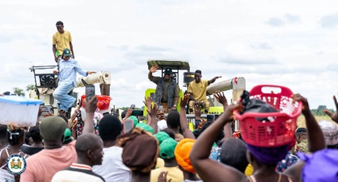
The three sites represent complementary approaches to expanding domestic production: commercial maize cultivation for the poultry and livestock industries, multiplication of improved rice seeds for farmers, and large-scale rice production to meet institutional needs.
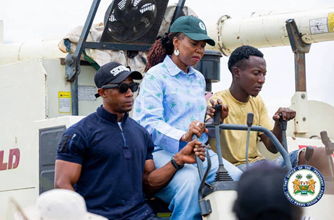
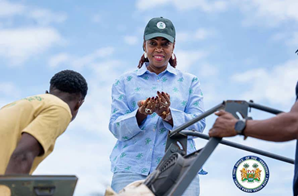
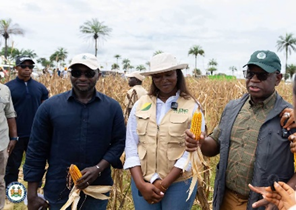
At Vaama Farm in Bai Largo, the President visited SLENC Limited, a women-led agricultural enterprise founded by engineer Sherilyn Cowan. The company has grown from a five-acre pilot operation to a mechanised hybrid maize farm covering 120 hectares in Kori Chiefdom. It employs more than 200 people and supplies maize for poultry feed, helping to support local businesses and reduce reliance on imported inputs.
Cowan briefed the President on the company’s expansion and the potential to increase production further with additional investment, particularly in irrigation infrastructure. Reliable irrigation could help farmers manage changing rainfall patterns, improve consistency and support production beyond the main growing season. She thank the First Lady for motivating young women in Sierra Leone to aspire for big goals in society. Engineer Cowan also thanked President Bio for creating the space for Sierra Leoneans, particularly women, to involve in agriculture and ensuring that Sierra Leoneans are food secured.
The visit underscored the value of backing businesses that are expanding domestic food production, while creating employment and supplying raw materials to local industries. President Bio said the Government wants agriculture to become a productive sector that provides opportunities and strengthens the country’s ability to grow the food it consumes.
“Our ambition is to build a productive agricultural sector that creates opportunities for our people, supports local businesses and strengthens Sierra Leone’s capacity to produce the food we consume,” he said.
SLENC’s maize production illustrates the link between farming and other parts of the economy. Locally produced maize can help supply poultry feed, supporting businesses that raise birds, and produce food for Sierra Leonean consumers. Expanding that supply chain could also create demand for more farmers, transporters, processors and other service providers.
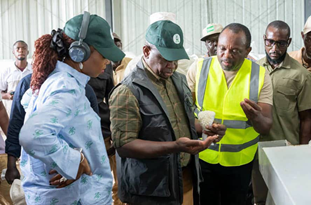
The President’s next stop was SMART Farms’ seed multiplication initiative in Moyamba District. The irrigation-supported centre is producing improved rice varieties developed by the Sierra Leone Agricultural Research Institute (SLARI). Its work connects agricultural research with the practical task of making quality planting materials available to farmers.
The centre is working with SLARI and Njala University to strengthen seed multiplication and improve farmers’ access to improved varieties. It has a reported yield potential of six metric tonnes per hectare, demonstrating the possibilities offered by better seed, research and irrigation when combined with effective farm management.

Improved seeds can help farmers raise yields and make better use of land and other inputs. But their potential depends on farmers being able to obtain reliable planting materials, as well as access to water, machinery, financing and markets. The seed multiplication programme is intended to address one of those essential foundations by increasing the supply of quality seed.
Minister Kpaka said that investment in improved seeds, irrigation, mechanisation and private-sector partnerships would be important to accelerating agricultural transformation.
“Feed Salone is about increasing productivity, strengthening local value chains and creating an enabling environment for farmers and agribusinesses to thrive,” he said. “Supporting these farms is essential to expanding domestic production and building a more resilient food system.”
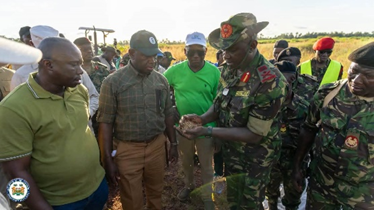
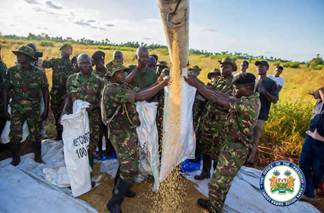
The tour concluded in Yoni, Kamajei Chiefdom, where President Bio joined a symbolic harvest at the Republic of Sierra Leone Armed Forces’ rice farm. The military’s agricultural programme spans six locations: Makally, Mankana and Rumbeh in Port Loko District; Masang in Tonkolili District; and Yoni and Tormabum in Moyamba District.
The Yoni operation covers approximately 4,227 hectares, according to information provided during the visit. It is expected to produce about 59,900 bags of clean rice. Under an off-taker agreement with the Ministry of Finance, the rice will meet the Armed Forces’ food requirements for six months.

The arrangement shows how agricultural production can serve institutional needs, while contributing to broader food security. By supplying part of the military’s food requirements from locally cultivated rice, the programme links public-sector demand with domestic production and gives large-scale farming a direct market.
President Bio praised the Armed Forces for contributing to national development and food production alongside their responsibility for protecting the country. “We are here to celebrate our farmers, especially the Military, for protecting and feeding our nation at the same time,” he said.
He also thanked farmers, entrepreneurs and institutions that have responded to the Government’s call to support Feed Salone. The visits, he said, were intended to showcase agricultural investment and encourage more Sierra Leoneans, particularly young people and private-sector operators to consider farming and agribusiness.
The President commended SLENC Limited, SMART Farms and the Armed Forces for demonstrating the potential contribution of private enterprise, agricultural innovation and institutional investment. He reaffirmed the Government’s support for private-sector participation, including efforts to connect commercial farms with out-growers and create employment opportunities for young people.
Taken together, the farms highlight different points in the food system. Commercial maize production can supply local industries such as poultry and livestock businesses. Seed multiplication can help farmers access improved planting materials. Large-scale rice cultivation can supply institutions and increase domestic food availability. Each depends on investment, infrastructure, skilled workers and dependable markets.
The visits also brought attention to practical challenges facing agricultural expansion. SLENC’s call for more irrigation investment reflects the importance of water management to reliable production. Mechanisation can help farmers prepare land and harvest more efficiently, while agricultural research can support the development and use of improved varieties. Partnerships between government, universities, research institutions and businesses can help move those innovations from trial plots to farms and markets.
Feed Salone places these priorities within a wider effort to make agriculture a driver of economic growth, employment and national food security. Its focus includes improved seeds, mechanisation, irrigation, research and private investment, alongside stronger local value chains. The aim is not only to grow more food, but also to create the conditions for farmers and agribusinesses to produce, process and sell it sustainably.
As Sierra Leone approaches World Food Day, the 2026 harvest-season visits offered a public demonstration of that approach. The farms in Moyamba District show how commercial operators, researchers and public institutions can contribute in different ways to a shared goal: increasing the amount of food produced locally and reducing dependence on imports.
For President Bio, the harvest was both a celebration of current efforts and a call for wider participation. The Government’s challenge will be to sustain investment, improve access to infrastructure and ensure that farmers can turn higher production into lasting livelihoods. The examples showcased in Moyamba suggest that partnerships across the sector can play an important role in meeting that challenge and in feeding Salone.