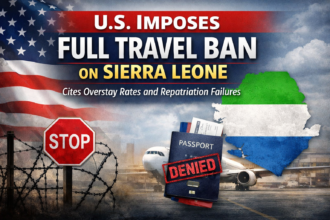
Sierra Leone has been placed under full U.S. entry restrictions following a new proclamation signed by Donald J. Trump on December 16, 2025, expanding America’s travel ban to additional countries the White House says pose national security and immigration enforcement risks.
According to the White House fact sheet, Sierra Leone—previously subject to partial limitations—will now face complete suspension of entry for its nationals, with limited exceptions. The decision is part of a broader move to tighten border controls and strengthen vetting procedures for foreign nationals entering the United States.
The U.S. government cited high visa overstay rates and poor cooperation on repatriation as key reasons for the escalation. Data from the Department of Homeland Security shows that Sierra Leone recorded a B-1/B-2 (business and tourism) visa overstay rate of 16.48 percent, while the student and exchange visitor (F, M, J) visa overstay rate stood at 35.83 percent. Similar figures were recorded in the 2023 overstay report, indicating a persistent pattern.
In addition, U.S. authorities said Sierra Leone has historically failed to accept back nationals ordered removed from the United States, a factor the administration views as a serious breach of immigration cooperation.
The proclamation allows exemptions for lawful permanent residents (green card holders), individuals with valid existing visas, diplomats, athletes, and cases deemed to serve U.S. national interests. However, the administration also noted it is narrowing family-based immigration carve-outs, citing fraud risks, while keeping discretionary, case-by-case waivers.
The move places Sierra Leone alongside countries such as Laos, Burkina Faso, Mali, Niger, South Sudan, and Syria under the strictest category of U.S. travel restrictions.
The White House said the measures are intended to pressure affected governments to improve identity verification systems, data sharing, and compliance with U.S. immigration law, adding that restrictions may be reviewed if meaningful progress is demonstrated.