
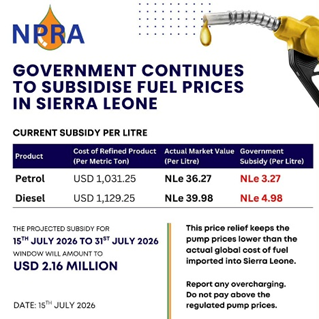
In a decisive move aimed at shielding Sierra Leoneans from the unpredictable swings of international oil markets, the Government of Sierra Leone has reaffirmed its commitment to maintaining affordable fuel prices across the country. Through substantial government subsidies, the National Petroleum Regulatory Authority (NPRA) announced that it will allocate approximately US$2.16 million for the period from July 15 to July 31, 2026, to keep pump prices below the prevailing international market rates. This initiative underscores the government’s resolve to cushion citizens and businesses from rising fuel costs, thereby supporting economic stability, transportation affordability, and social welfare.
The global petroleum industry has been characterized by heightened volatility in recent years, driven by geopolitical tensions, supply chain disruptions, and shifts in global demand. These fluctuations typically translate into increased fuel prices at the pump, which can have far-reaching implications for everyday life, economic productivity, and national development. Recognizing these challenges, the Sierra Leonean government has prioritized strategic intervention to mitigate the adverse effects on its populace.
NPRA’s latest announcement reveals that, under current international market conditions, the actual cost of imported petroleum products would necessitate significantly higher retail prices if not for government subsidies. This intervention is vital in ensuring that fuel remains affordable for all Sierra Leoneans, especially given the importance of transport in everyday life and economic activities.
Understanding the specifics of the subsidy provides insight into the government’s strategic approach. For petrol, the current market cost of refined product stands at US$1,031.25 per metric ton, which translates into an actual market value of NLe36.27 per litre. However, the government is subsidizing NLe3.27 per litre, allowing consumers to purchase petrol at the regulated pump price of NLe33.00 per litre; a significant reduction from what the true market value would suggest.
Similarly, for diesel, the current cost of imported refined petroleum is US$1,129.25 per metric ton, equating to NLe39.98 per litre on the market. The government absorbs NLe4.98 per litre, maintaining the official retail price at NLe35.00 per litre. These subsidies demonstrate a proactive effort by the government to prevent sharp increases in fuel prices, which could otherwise ripple through the economy, affecting transportation costs, commodity prices, and household budgets.
NPRA emphasizes that these subsidies are crucial in maintaining a stable and predictable fuel market. By keeping pump prices below international rates, the government aims to prevent inflationary pressures that often accompany rising fuel costs. Fuel price stability is essential not only for consumers but also for businesses that rely heavily on transportation and logistics. The continued affordability of fuel is vital for the smooth functioning of supply chains, agricultural productivity, and industrial output.
The agency also reminds the public that no fuel station is authorized to charge above the regulated prices of NLe33 per litre for petrol and NLe35 per litre for diesel. Consumers are encouraged to report any instances of overcharging to ensure compliance with regulatory standards. This call to vigilance underscores the government’s commitment to consumer rights and transparency in the petroleum sector.
The latest subsidy measures are part of a broader reform agenda led by NPRA’s Director General, Brima M. Baluwa Koroma, who took office in early July 2025. Since assuming leadership, Mr. Koroma has prioritized modernizing Sierra Leone’s downstream petroleum industry through a series of regulatory, infrastructural, and policy reforms aimed at fostering transparency, efficiency, and strategic investment.
His leadership has marked a departure from traditional practices, emphasizing openness, accountability, and industry collaboration. These reforms are designed to create a more resilient, transparent, and competitive petroleum sector capable of withstanding external shocks and attracting both domestic and international investment.
One of NPRA’s notable achievements under the current leadership has been the enhancement of regulatory oversight through widespread inspections of petroleum filling stations nationwide. These inspections serve multiple purposes: ensuring compliance with quality and safety standards, preventing adulteration, and safeguarding consumers from unfair practices such as under-dispensing or overcharging. Strengthening quality control measures is crucial in maintaining trust in petroleum products and protecting public safety.
Additionally, the Agency has instituted a more robust public complaints mechanism, allowing consumers to confidentially report violations. This initiative empowers citizens to play an active role in safeguarding their rights and enhances accountability within the petroleum supply chain.
NPRA recognizes that regulatory reforms are most effective when complemented by industry engagement. Accordingly, the Agency has institutionalized regular consultations with oil marketing companies, petroleum dealers, and transport unions. These dialogues facilitate open communication on pricing strategies, supply challenges, and regulatory improvements, fostering a collaborative environment conducive to sustainable growth.
By promoting transparency and dialogue, NPRA aims to strike a balance between consumer protection and the operational needs of industry stakeholders. Such engagement is vital for addressing market challenges proactively and ensuring a stable supply of petroleum products.
Beyond pricing and regulation, NPRA has prioritized public safety and environmental protection. Nationwide awareness campaigns have been intensified to educate the public on the safe handling, transportation, and storage of petroleum products. These campaigns are vital in reducing fire incidents, environmental hazards, and health risks associated with petroleum operations.
The Agency’s holistic approach recognizes that petroleum industry safety extends beyond regulation to community awareness and environmental stewardship. Proper handling and storage of fuel are critical in safeguarding lives, property, and Sierra Leone’s fragile ecosystems.
Looking to the future, NPRA is actively encouraging investment in critical petroleum infrastructure to enhance Sierra Leone’s energy resilience. The Agency is promoting the resuscitation of the national oil refinery, the construction of regional tank farms, and initiatives to improve bulk transportation and retailing. These infrastructural projects are instrumental in reducing supply disruptions, lowering operational costs, and creating employment opportunities.
By strengthening storage capacity and ensuring the availability of refined petroleum products, Sierra Leone can reduce its dependence on imports, control prices more effectively, and improve energy security. Such infrastructure investments are aligned with the government’s broader development goals of economic diversification and sustainable growth.
Enforcement of petroleum legislation remains a cornerstone of NPRA’s strategy. The Agency is committed to ensuring full compliance with licensing, taxation, and operational standards. Transparency and professionalism are emphasized to attract investment from both domestic and international players. A predictable regulatory environment is essential for confidence in Sierra Leone’s downstream petroleum sector.
In this context, NPRA is engaging with international petroleum institutions, including the World Petroleum Council and the Africa Refiners Association. These collaborations facilitate knowledge exchange, access to global best practices, and industry partnerships that can accelerate sector development.
Innovation plays a significant role in NPRA’s modernization efforts. The Agency is preparing to introduce a digital petroleum product tracking system that will enhance supply chain monitoring, reduce fraud, and improve operational efficiencies. Such technological advancements are vital in ensuring transparency and accountability in the sector.
Furthermore, plans are underway to expand NPRA’s regional offices, bringing regulatory services closer to operators and consumers. Decentralizing regulatory functions will improve service delivery, foster local engagement, and facilitate timely response to industry challenges.
Industry stakeholders have welcomed the reforms under Mr. Baluwa Koroma’s leadership, noting that increased transparency, predictable regulation, and stakeholder engagement have strengthened confidence within the petroleum sector. Many see Sierra Leone’s renewed focus on building a resilient downstream industry as a positive trajectory toward sustainable development.
Despite ongoing global uncertainties, NPRA maintains that strategic reforms, infrastructure investments, and consumer protection measures will continue to underpin affordable fuel supplies. These efforts are integral to attracting investment, supporting economic growth, and achieving long-term energy security.