Bio Highlights Success Of Feed Salone Initiative
By Alex Lawrence Koroma
MAGBURAKA, Tonkolili District —
President Julius Maada Bio has said food prices are falling in Sierra Leone for the first time in the country’s history, citing increased local production and reduced food imports under the Feed Salone initiative.
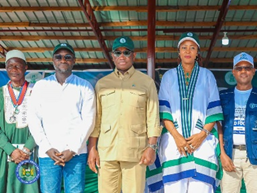
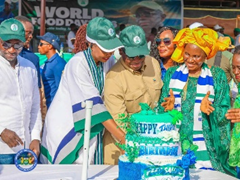
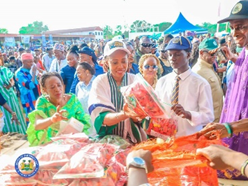
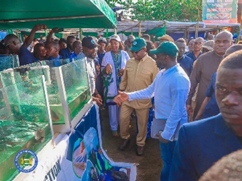
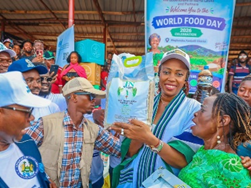
The President made the remarks on Thursday, 22 October 2026, at Ernest Bai Koroma University of Science and Technology in Magburaka, where he joined First Lady, Fatima Bio, The Minister of Agriculture and Food Security, Dr. Henry Musa Kpaka, other government officials, local authorities, farmers, local and international partners to mark World Food Day and launch Feed Salone’s third-year report. The celebration was held under the theme, “Innovate Today and Nourish Tomorrow.”
President Bio said the government’s agricultural programme was intended to make Sierra Leone more self-reliant, create employment and improve food access. He described food sovereignty as an important part of national independence, arguing that the country should produce more of what its people consume rather than rely heavily on imported supplies.
“Food security is a matter of national security and national dignity,” he said. “We must increase local production, strengthen our farmers, and build the capacity to produce more of what we consume.”
President Bio further stated that, food prices had improved compared with the period when he took office, and pointed to onions as one commodity that had previously posed a particular challenge. He also said food importation had fallen over the past three years, including imports of poultry.
“This is the first time in the history of Sierra Leone that food prices are going down,” he said. “Before now, food prices were high, but now, it is better.”
The President’s assessment comes alongside figures presented at the event by The Minister of Agriculture and Food Security, Dr. Henry Musa Kpaka, showing progress in domestic production and food security. According to Minster Kpaka quoting from the Feed Salone report, severe household food insecurity declined from 28% in September 2023 to 13 % in July 2025. The initiative also supported more than 22,000 direct and indirect jobs during its third year.
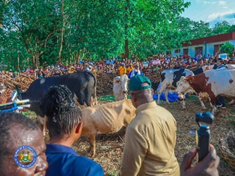
Minster Kpaka and President Bio said the number of poultry layers had risen from 250,000 to 600,000 in three years. President Bio also cited increased rice production at Fambu and Tormabum, and said the CDS farm planned to expand from 5,000 acres to 15,000 acres next year.
“Twenty-two thousand jobs have been created in 2026 under Feed Salone,” he said. “In three years, food importation has fallen. We have reduced the importation of poultry.”
He added that nearly three out of every four cups of rice consumed in Sierra Leone now came from local production, while urging continued investment to increase domestic supply.
Tonkolili, the President noted, was known for Iron Ore Mining, cassava and maize production and shared borders with several districts, giving it a role in the country’s agricultural development. He said Port Loko and Tonkolili were among the districts making efforts to advance the Feed Salone agenda.
Minister Kpaka spoke about President Bio’s personal involvement in poultry farming, saying that the President had initially supported the initiative with 3,000 birds, and in recent time, increased to 10,000, supporting poultry farming. He said the example reflected the potential for agricultural enterprise to grow, while calling on farmers and businesses to expand production.
The President urged investment in improved seeds, irrigation, mechanisation, research, financing and emerging technologies, including drones, adding that agricultural research institutions such as the Sierra Leone Agricultural Research Institute (SLARI) were working to provide farmers with improved seeds.
President Bio furthered that farming should become a profitable business for young people and women, supported by reliable markets, storage, transport and processing facilities. He called for a shift from producing crops solely for local consumption, towards building the capacity to process and export agricultural goods.
“I want farmers to produce for food and for export to other countries,” he said. “Agriculture must become industrialized.”
He said his government wanted to put more money in farmers’ pockets and make agriculture a foundation for industrial development. The President also referred to infrastructure, saying 400 kilometres of roads had been completed across the country and that improved transport links could help farmers move produce to markets.
Bio praised private-sector involvement, singling out Pee Cee and Sons for its contribution to the country’s development. He said government’s efforts would need to be matched by investment from businesses and other partners if agricultural production and processing were to expand.
First Lady Fatima Bio said the government had expanded agricultural mechanization, and that Feed Salone was contributing to employment, farmers’ earnings and women’s economic independence. She said farmers had gained access to loan facilities and machinery support.
“Sierra Leone now exports food out of the country,” she said, adding that the programme had helped create more opportunities for young people and increase farmers’ incomes. “There is financial independence for women because of Feed Salone. Farmers now have loan facility and machinery support.”
“When a woman succeeds, the nation succeeds,” she said. The First Lady also commended the minister for improving the road leading to the farm.
Agriculture and Food Security Minister, Dr Henry Musa Kpaka, said rice self-sufficiency had risen, onion imports had declined and domestic poultry production had expanded. He highlighted investments in seed production, rice processing, agricultural infrastructure and school feeding.
Nearly one million schoolchildren received meals during the previous academic year, Kpaka said, with an increasing proportion of the food sourced locally. The school-feeding programme, Bio also noted, was one area where Feed Salone was supporting both nutrition and local farmers.
Looking ahead to the initiative’s fourth year, Kpaka said the government would focus on making existing investments fully productive. Priorities include completing irrigation and rice-processing facilities at Tormabum and Gbondapi, and expanding financing and commercial opportunities for farmers, particularly women and young people.
President Bio acknowledged that progress had not eliminated hardship for every household. “Some families still face challenges in having food, but government is trying to solve it,” he said. He described his ambition for every Sierra Leonean to have a good education and sufficient food as a legacy he hoped to leave.
The event also brought together traditional leaders, farmers’ representatives, development partners and officials. Paramount Chief Dr Masakà Madibie II, National Chairman of the Council of Paramount Chiefs, welcomed the initiative and pledged continued support for farming and peaceful communities.
The Food and Agriculture Organization’s country representative, Saeed Abubakar Banice, commended the government’s progress and called for greater investment in climate-smart agriculture, modern technology, and opportunities for women and young people. Fisheries and Marine Resources Minister, Princess Dugba, highlighted the fisheries sector’s contribution to domestic food supply. Dr Kandeh Yumkella, chairman of the Presidential Initiative on Climate Change, Renewable Energy and Food Security, stressed the importance of advancing the wider Feed Salone agenda.
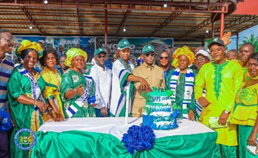
National Farmers Federation President, Yeatta Sama, encouraged more Sierra Leoneans to take up farming and commended support for local producers.
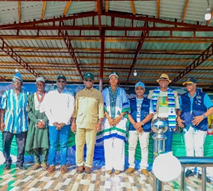
The celebration concluded with awards to ten farmers, entrepreneurs and agricultural champions recognised for contributions to food production, innovation, processing and the Feed Salone programme. Recipients included Lieutenant General Amara Idara Bangura for his leadership role in the RSLAF farm; Monica Kwame Greene for agricultural programme coordination; Sitta Isata Kai Kai for local production through Mulu Poultry and Chuma Agro Company Limited; and Hannah Elizabeth Tarawally for Coffee Couriers’ contribution to agricultural development.
Other awardees included Paramount Chief Bai Fonti Thangbathi II, recognised for advancing food production and domestic rice supply; Safinatu Bockarie of Evergreen Women, for inland valley swamp farming and women’s participation in agriculture; and Saffie Kalokoh, for sustainable agricultural innovation and vegetable production. Peter Dawah was recognised for work in goat farming and livestock production, John Shallop for agricultural processing and value addition through House of Beans, and Binta Bio for investment in domestic rice production through Godwill Investment SL Ltd.
The government’s central challenge, speakers said, is to turn increased production into lasting improvements in affordability, incomes and food access. Feed Salone’s next phase is expected to focus on putting current investments to work, strengthening agricultural value chains and expanding opportunities for producers.
Bio closed with a call for national ownership of the agricultural transformation effort: “Wetin wi plant, na im wi go eat. Salone go feed insɛf.”