By: Alimatu Kargbo
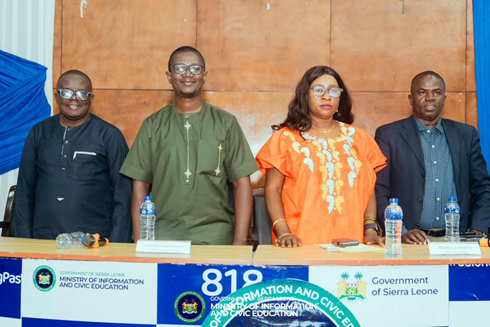
Concerns over governance, service delivery, and national cohesion took centre stage at the Ministry of Information and Civic Education’s weekly press conference held at the Miatta Conference Centre, where key stakeholders addressed pressing national issues.
The session featured statements from the Minister of Social Welfare, Melrose Karminty, the Director of the Decentralization Secretariat, Alex Bhonapha Esq., and the Executive Director of Accountability Now Sierra Leone, William Sao Lamin, each speaking on critical topics affecting the country.
Legal Position on Council Boycott
Addressing the legal implications of local councils withdrawing from operations, Alex Bhonapha Esq., Director of the Decentralization Secretariat, firmly stated that councils cannot lawfully boycott government.
He explained that under the Local Government Act, councils are established as corporate bodies with perpetual succession, making them independent legal entities distinct from individual office holders or political actors.
“There is no way a council can boycott itself,” Bhonapha said, noting that councils remain the highest political authority at the local level, mandated to maintain law and order, oversee development, and deliver essential services.
He further highlighted that even in the absence of elected officials, administrative continuity is guaranteed through the Chief Administrator, who serves as the vote controller, in line with both the Local Government Act and the Public Financial Management Act.
According to him, a legal opinion from the Attorney General has reaffirmed that councils must continue to function, ensuring salaries are paid, services are delivered, and governance is maintained without interruption.
In her contribution, Melrose Karminty, Minister of Social Welfare, raised concerns about the negative impact of disruptions within government institutions, describing the situation as a threat to effective service delivery.
She noted that delays in administrative processes, such as approvals, payments, and documentation, are already affecting citizens, particularly those who rely heavily on public services.
“When offices slow down or people are absent, services are delayed, and that creates opportunities for corruption,” she warned.
The Minister emphasized that vulnerable groups, including persons with disabilities and low-income earners, are the most affected during such disruptions, as they depend on timely government interventions.
She further pointed out that the ripple effects extend to businesses and the wider economy, with increased costs and reduced productivity placing additional strain on citizens.
“It is about the people. Government must continue to function, and services must be delivered efficiently,” Karminty stressed.
William Sao Lamin, Executive Director of Accountability Now Sierra Leone, spoke on the outcome of a recent engagement with religious leaders aimed at promoting tolerance and peaceful coexistence.
He disclosed that the meeting ended with the signing of a communiqué committing religious leaders to promote messages of peace, discourage incitement, and strengthen interfaith collaboration.
“Religion should be a force for unity, not division. Sierra Leone has long been known for its religious tolerance, and that is something we must protect,” Lamin said.
He warned against the dangers of inflammatory rhetoric, noting that statements from influential leaders can significantly shape public behaviour and, if misused, threaten national stability.
Lamin described religious tolerance as one of Sierra Leone’s defining strengths, urging continued dialogue and cooperation among faith communities to preserve the country’s peace.
The press conference concluded with a collective call for responsibility among political leaders, public officials, and citizens to prioritize national interest over partisan considerations.
Speakers emphasized that maintaining effective governance, ensuring uninterrupted service delivery, and preserving unity are essential to the country’s development and stability.