Parliament Exposes Illegality of
Chancellor’s Action
Freetown, June 22, 2026 —
The Parliamentary Committee on Technical and Higher Education has launched a thorough inquiry into the controversial suspension of Professor Philip John Kanu, Vice Chancellor and Principal of Milton Margai Technical University (MMTU). The committee is scrutinizing whether Chancellor Engineer Mohamed Alie Jalloh acted within his legal authority when he unilaterally suspended Prof. Kanu without securing the approval of the University Court, MMTU’s highest governing body.
The hearing, held last Friday, June 19, in the parliamentary chamber, was chaired by Honorable Joseph Williams Lamin and attracted considerable attention due to escalating governance disputes surrounding the university. Lawmakers expressed deep concern about the implications of such unilateral decisions on the stability and integrity of higher education institutions in Sierra Leone.
Central to the committee’s investigation is the university’s governance framework, which mandates that major administrative decisions must be collectively approved by the University Court. Members questioned whether the Chancellor’s actions adhered to these protocols, emphasizing that no single office holder should override the Court’s authority.
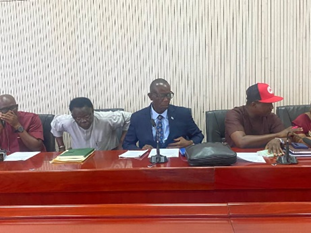
Hon. Alpha Ben Mansaray, Chairman of the Committee, underscored the critical need for robust parliamentary oversight in tertiary education governance. He warned that unchecked leadership conflicts risk undermining years of government investment aimed at improving educational standards.
“We are not here to engage in politics; our focus is ensuring the future of our tertiary institutions. It would be deeply regrettable if constant power struggles hinder progress after significant public resources have been committed,” Hon. Mansaray remarked firmly.
Officials from the Ministry of Technical and Higher Education also testified before the committee, including the Director of Higher Education, who provided detailed explanations regarding the powers of university governing bodies and the specific legal remit of chancellors. Lawmakers from both ruling and opposition parties sought clarity on whether the Chancellor has the mandate to make significant institutional decisions or enter into agreements without prior endorsement from the University Court.
Committee members repeatedly stressed that governance should rest on collective decision-making. “No law grants the Chancellor the power to act independently of the University Court on matters requiring its approval. The Chancellor’s authority is derived from, and limited by, the Court itself,” one member stated.
Further probing revealed concerns that some of the contested decisions were taken soon after the University Court had convened and passed resolutions on those same issues, raising questions about procedural propriety.
The session also highlighted a worrying pattern of governance disputes across multiple tertiary institutions nationwide, which have created instability and drawn public criticism. Some lawmakers advocated for the direct involvement of the Minister of Technical and Higher Education to explain her ministry’s role and oversight in resolving such conflicts. Although the minister was unable to attend due to official engagements abroad, the committee hinted that her appearance might be necessary in the near future.
Throughout the proceedings, committee members urged all parties to set aside personal animosities in favour of prioritizing the welfare of students, staff, and the nation’s educational development.
“What we see here is less about policy and more about personality clashes that jeopardize institutional growth. The interests of the nation and its youth must come first,” another committee member emphasized.
In closing, Hon. Mansaray reiterated Parliament’s commitment to upholding the rule of law within university governance, ensuring transparency, accountability, and the advancement of quality education.
The committee’s inquiry into the MMTU governance crisis is expected to continue for several weeks, with additional witnesses slated for summons. The aim is to determine conclusively whether proper legal procedures were observed and to recommend measures to prevent future administrative conflicts.
As Sierra Leone’s premier technical institution grapples with internal turmoil, the outcome of this parliamentary probe will be crucial in shaping the governance and stability of higher education institutions across the country.