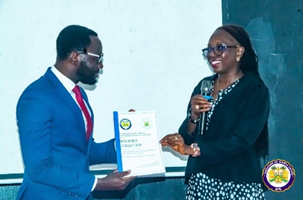
28th August, 2026 at Sierra Palms Resort Aberdeen. The Judiciary has formally handed over a Gender Equality and Women’s Empowerment (GEWE) Resource Document to stakeholders within the Justice Sector, marking another significant step towards strengthening gender-responsive practices and capacity within the sector.
Representing the Hon. Chief Justice, Hon. Justice Komba Kamanda, Hon. Justice Jamesina Essie King of the Court of Appeal said the Hon. Chief Justice remains highly committed to the process and expressed satisfaction at seeing the initiative reach a significant stage with the development and collection of concrete resources.
She emphasized that the successful completion of the process now places a collective responsibility on stakeholders to ensure that the contents of the resource document are properly and fully implemented.
Justice King explained that the document is primarily a capacity-building resource designed to benefit anyone interested in gender equality and issues relating to gender. She noted that it provides useful guidance and resources that can contribute to greater understanding and effective mainstreaming of gender considerations within the Justice Sector.
Reflecting on recent developments in gender equality and women’s empowerment, Justice King recalled her participation in a programme at the Ministry of Gender, where a report on the implementation of the Gender Equality and Women’s Empowerment Act, together with its Monitoring and Accountability Framework, was launched.
She disclosed that the report highlighted notable levels of female representation within the Judiciary. According to the figures presented, women constitute approximately 71 percent of magistrates, while women account for 29 percent of judges.
Justice King noted that the statistics provide an important basis for continued reflection, capacity building and institutional efforts aimed at advancing gender equality and women’s empowerment across the justice system.
She concluded by underscoring the importance of translating the resources contained in the GEWE document into practical action, stressing that its impact will ultimately depend on the commitment of justice-sector stakeholders to effectively implement its recommendations and principles.
Speaking on behalf of The Carter Center, Mr. Mohamed Bobor Jalloh, Rule of Law Project Coordinator, described the validation process as a major milestone under the Center’s Rule of Law Programme in Sierra Leone, particularly in its collaboration with the Judiciary.
Mr. Jalloh disclosed that in 2024, The Carter Center secured funding through Democracy International, supported by USAID, to implement the Gender Equality and Rights in the Justice Sector (GEAR) Project. He noted that the project is being executed in partnership with the Justice Sector Coordinating Office (JSCO) and other key stakeholders, with a focus on supporting the Judiciary in implementing the Gender Equality and Women’s Empowerment (GEWE) Act, 2022.
According to him, the initiative aims to enhance gender equity practices within the Judiciary and across the broader justice sector. As part of this effort, gender diagnostics have been conducted in selected Magistrates’ Courts, with findings informing targeted gender-sensitization training, the development of GEWE implementation and monitoring plans, awareness-raising campaigns, and the review of human resource policies.
In his statement, the head of the Justice Sector Coordination Office (JSCO) in Sierra Leone Mr. Shahid M. Korjie, commended Judiciary for its partnership and contribution to the GEWE Project, with special recognition given to the leadership of the Hon. Chief Justice for creating an enabling environment for the project’s diagnostic exercise to reach it highest pick.
“Let me underscored the pivotal role played by the Judiciary, with particular commendation for the leadership and commitment of the Hon. Chief Justice, whose support and dedication created the enabling environment necessary for the successful conduct of the diagnostic exercise.” Mr. Korjie expressed with passion.
Mr. Korjie stressed that sustained cooperation among the Judiciary, legal practitioners, development partners and other relevant institutions would remain essential to strengthening the implementation of the project and ensuring that its objectives are fully achieved.
He emphasized that the progress recorded under the GEWE Project was a product of collective effort and collaboration among key stakeholders and institutions.
He further commended the Certer Center for its partnership and technical support throughout the implementation of the project and same for L.A.W.Y.E.R.S, the Ministry of Gender and other relevant organizations including CARL.
It could be recalled the Hon. Chief Justice has shown his strongest commitment by assigning judges and senior judicial staff to participate at every given stage.
At the validation stage held on the 24th July, 2026 at Country Lodge Hotel, Hill Station, Hon. Justice Sesay representing the Hon. Chief Justice said that under the current leadership of Hon. Chief Justice Komba Kamanda, the Judiciary has recorded notable improvements in the recruitment and promotion of women, particularly within the Magistrates’ Courts and across strategic administrative roles.
He underscored that the adoption of Gender-Sensitive Human Resources Guidelines is fundamental to ensuring that justice delivery remains fair, inclusive, and responsive to the needs of all individuals, regardless of gender. According to him, such guidelines are critical in strengthening the legal system and upholding the principle of equality before the law.
Justice Sesay explained that the guidelines are designed to promote equality and non-discrimination by ensuring that courts treat all persons—men, women, and gender minorities—with fairness and respect. He noted that they will help guard against bias, stereotypes, and discriminatory practices that may influence judicial decision-making or courtroom procedures.
For more information, please contact the Judiciary of Sierra Leone Communications and Public Affairs Unit or visit the Judiciary’s website on www.judiciary.gov.sl or follow our official social media platforms.