

Speaker’s Absence Sparks Wild Speculations
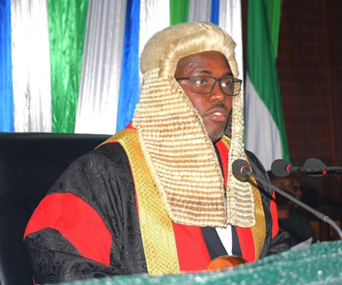
Questions have emerged about the whereabouts of Sierra Leone’s Speaker of Parliament, Rt. Hon. Segepoh Solomon Thomas, after he did not attend a Supreme Court hearing on Wednesday in a significant constitutional dispute.
The Speaker’s lawyer, Hon. Hindolo Gevao Esq., told the Court that his client was unable to attend because he was suffering from diarrhoea and was absent on medical grounds. That explanation is the documented account given to the Court.
However, claims have since circulated that the Speaker was seen in neighbouring Guinea around the same period. The reported sighting has not been independently verified. Until reliable evidence is available, it remains an allegation rather than an established fact.
The claims have nevertheless prompted public discussion because of the timing and importance of the court proceedings. The Supreme Court case concerns the controversial Constitutional Amendment Bill, 2025, and challenges to the process by which it was passed in Parliament. Among the issues before the Court is whether the necessary constitutional voting threshold was met.
Speaker Thomas is closely connected to the dispute, because he presided over the parliamentary proceedings during which the Bill was passed. He had previously ruled that a simple majority could apply to the Bill, while also referring the constitutional question to the Supreme Court for an opinion.
His absence from a hearing addressing the controversy has therefore drawn attention to the explanation given on his behalf. The case concerns not only the interpretation of a particular vote, but also parliamentary procedure and the operation of Sierra Leone’s Constitution.
The situation has led some members of the public to ask whether the Speaker’s absence was solely due to illness or whether other circumstances were involved. Those questions cannot be answered on the basis of unverified reports alone. The Speaker’s lawyer’s statement remains the formal explanation presented in court, while the Guinea claim requires independent confirmation.
The issue is not whether a public official can become ill. Like anyone else, the Speaker may be unable to attend an engagement for medical reasons. Rather, the debate centres on clarity and public confidence: whether the explanation can be understood in the context of the claims now circulating, and whether those claims are accurate.
If the Speaker was medically unfit to attend, further clarification could help address public concern. If the reported sighting in Guinea is false, a clear denial could help prevent speculation from gaining ground. If evidence eventually confirms that he was in Guinea, an explanation of the circumstances would also be relevant to public discussion. At this stage, however, none of those possibilities should be presented as fact.
The Supreme Court is being asked to consider questions with significant implications for constitutional governance. The outcome may help clarify how the voting requirements for the amendment should be interpreted and whether Parliament followed the required process. The presence or absence of any individual does not determine the Court’s decision, but the circumstances surrounding the hearing may influence public perceptions of the process.
For that reason, transparency is important. Public trust depends not only on the courts’ ability to hear and decide cases according to law, but also on confidence that public institutions and their leaders are acting openly and responsibly. Where questions arise about a senior official’s absence from proceedings of national importance, clear and accurate information can help distinguish fact from rumour.
The competing accounts have also highlighted the need for caution in reporting claims that have not been independently verified. A reported sighting, without corroborating evidence, should not be treated as proof. At the same time, the public’s interest in understanding the circumstances is legitimate, given the Speaker’s role in the parliamentary proceedings under challenge.
For many Sierra Leoneans, the central question is straightforward: what explains the Speaker’s absence, and can the public be confident that the information provided is complete? The answer will depend on verified facts, not speculation.
As the constitutional case continues, attention is likely to remain on both the legal arguments and the events surrounding the hearing. The Court’s task is to assess the constitutional issues before it. The responsibility of public officials and institutions, meanwhile, is to help ensure that the process is understood and that public confidence is maintained.