
President Bio & Dr Kpaka’s Feed Salone Drive Gains Momentum
By Alex Lawrence Koroma
As Sierra Leone works to produce more of its own food, reported progress under the Feed Salone initiative offers a contrast with allegations over agricultural procurement in neighbouring Liberia. The comparison highlights a basic test for any public programme: ambition and investment plans matter, but public confidence also depends on transparent spending, verifiable delivery and effective oversight.
Sierra Leone’s effort is led by President Julius Maada Bio’s government, with Agriculture and Food Security Minister, Dr. Henry Musa Kpaka, responsible for advancing Feed Salone, launched in 2023 to boost local production and reduce dependence on imported food, particularly rice. The initiative aims not only to grow more crops, but also to strengthen the systems that help farmers obtain inputs, store and process harvests, and get produce to market.
Across the border, Liberia’s Agriculture Minister, Dr. J. Alexander Nuetah, is facing questions about government spending on agricultural supplies. Nimba County District #5 Representative, Kortor Sehwongbay Kwagrue, alleges that nearly US$800,000 intended for farm inputs cannot be accounted for. The allegation has not been established as fact, but it has drawn attention to the importance of clear contracts, documented deliveries and credible public oversight.
In Sierra Leone, the government says Feed Salone is making progress on several fronts. The Agriculture Ministry has reported that the share of rice consumption supplied by local production rose from 62 per cent in 2022 to 73 per cent by 2026. A Feed Salone progress report also cites 661,016 hectares under rice cultivation and an average yield of 2.37 tonnes per hectare. These figures suggest increased production capacity and movement towards greater food sufficiency, although they do not mean that the country has already achieved self-sufficiency.
The programme has also attracted reported investment pledges exceeding US$1 billion, while the agriculture budget allocation has reportedly risen above 8 % . The figures signal growing attention to the sector, but pledges should be distinguished from money actually released and projects completed. Their lasting value will depend on whether financing reaches viable projects and produces measurable benefits for farmers and consumers.
Mechanization and employment are among the other priorities. The government has reported certified 175 young tractor drivers, with the aim of developing machinery service providers to support farmers. In 2025, programme reports also cited the launch of Sierra Leone’s first crop-insurance initiative, intended to help farmers manage climate-related and production risks.
A cited food-security report said severe household food insecurity fell from 28 % in 2023 to 13% in 2025. That is an encouraging trend, but food security is affected by many forces not agricultural policy alone. Prices, household incomes, weather conditions and people’s access to markets all shape whether families can obtain enough food.
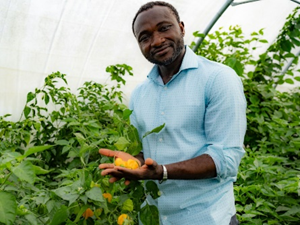
Dr. Kpaka’s contribution has been to lead and promote a national programme focused on domestic production, rice, investment, mechanization and farmer resilience. The reported results are more accurately described as Feed Salone and ministry achievements, supported by President Bio, ministry staff, farmers, private businesses and development partners. National food-security outcomes cannot be attributed to one minister alone, but because of his strong leadership qualities results are visible in the sector.
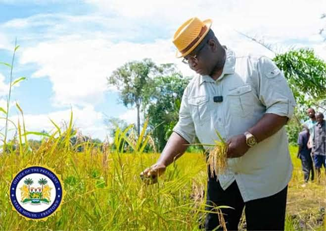
A recent example of the government’s approach was President Bio’s opening of the 2026 harvest season. On 17 October, accompanied by First Lady Fatima Maada Bio and Minister Kpaka, His Excellency took part in symbolic maize and rice harvesting at three agricultural sites. The visits showcased different parts of the food-production system: commercial maize farming, improved seed multiplication and large-scale rice cultivation.
At SLENC Limited’s 120-hectare maize farm in Kori Chiefdom, the company’s founder and Chief Executive, Eng. Sherilyn Cowan, described its growth from five hectares to its current size and said it employed more than 200 people. She also highlighted the need for further investment in irrigation to increase production.
The farm illustrates how private agricultural businesses can contribute to domestic supply, jobs and raw materials for local industries. President Bio said the government wanted to build a productive agricultural sector that creates opportunities, supports local businesses and strengthens the country’s ability to produce the food it consumes.
The President and Minister Kpaka also visited a Seed Multiplication Centre managed by Smart Farms at Kangahun. The centre is working with Njala University and the Sierra Leone Agricultural Research Institute, or SLARI, to improve seed multiplication and farmers’ access to quality planting materials. Its improved varieties are reported to have a yield potential of six metric tonnes per hectare.
Better seed can help raise productivity, but it must be available at the right time and at a price farmers can afford. It also needs to be supported by irrigation, machinery, extension advice and access to markets. Kpaka has emphasized the need to combine these investments rather than treat them as separate initiatives.
The tour ended at the military rice farm in Yoni, covering approximately 1,400 hectares. President Bio participated in a symbolic harvest and commended the military for supporting Feed Salone. Together, the three sites demonstrated the complementary roles of commercial maize, seed development and large-scale rice production. Maize can support poultry and livestock feed, while improved seeds and rice production contribute to domestic food supplies and reduce reliance on imported grain.
For Feed Salone to meet its broader goals, however, visible activity must be matched by reliable implementation. Farmers need irrigation that works, machinery they can access, financing they can repay, and roads and storage that allow crops to reach buyers before they spoil. Investment figures and harvest ceremonies can help draw attention to agriculture, but sustained gains will depend on practical delivery.
That is also where the Liberia allegations offer a useful, though not conclusive, regional reminder. Allegations should be treated as allegations unless substantiated, but they underscore why public programmes need transparent procurement and clear records of what was purchased, where it went and who received it. Strong oversight protects both public money and the credibility of agricultural programmes.
Sierra Leone’s reported rise in local rice’s share of consumption, investment pledges, youth training and crop insurance point to momentum. The harvest-season visits also highlight the potential contribution of private farms, research institutions and public institutions. Yet progress towards food sufficiency will ultimately be judged by outcomes: whether local production continues to grow, whether prices become more affordable, and whether farmers and households benefit.
Under Dr. Kpaka’s leadership, Feed Salone has placed domestic production and agricultural resilience at the centre of the government’s food-security agenda. The challenge now is to convert plans and reported achievements into lasting improvements across the country. That requires sustained investment—and transparent evidence that resources are reaching farms and delivering results.