By: Alimatu Kargbo
Deputy Minister of Technical and Higher Education, Sarjoh Aziz-Kamara, has reaffirmed the Government of Sierra Leone’s commitment to transforming the country’s education system by placing greater emphasis on technical and vocational education, skills development and job creation.
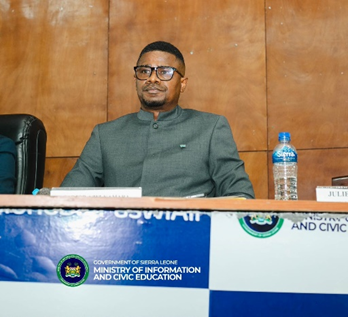
Speaking during the Ministry of Information and Civic Education’s weekly press briefing, Aziz-Kamara said the government has deliberately expanded higher education institutions, while shifting focus from certificate-based learning to practical, industry-driven skills.
He noted that Sierra Leone has doubled the number of public universities from three to six, describing the expansion as part of a broader strategy to widen access to higher education and strengthen human capital development.
According to the Deputy Minister, the government has also transformed several polytechnics into technical universities and established the University of Science and Technology to better prepare graduates for the demands of the modern labour market.
“We are moving away from an education system that is heavily focused on certification towards one that equips young people with practical skills that industries need,” he said.
Aziz-Kamara explained that while academic education remains important, Technical and Vocational Education and Training (TVET) is central to producing a skilled workforce capable of supporting national development.
He revealed that the government, through its TVET policy introduced in 2019, secured a US$20 million Skills Development Fund with support from the European Union. The fund is financing training programmes in priority sectors, including construction, carpentry, mining, ICT, agriculture and other technical fields.
To ensure training programmes respond to labour market demands, the ministry has conducted a nationwide labour market survey to identify sectors with the greatest employment potential.
The survey identified agriculture, automotive engineering, construction, fisheries, hospitality and tourism, manufacturing, mining and extractive industries as key growth sectors requiring skilled workers.
“The goal is not simply to produce graduates, but to produce graduates with the practical competencies employers are looking for,” the Deputy Minister stressed, warning that pursuing qualifications without relevant skills could contribute to graduate unemployment.
He said the reforms support President Julius Maada Bio’s “Big Five Game Changers” agenda, particularly the target of creating 500,000 jobs through investments in human capital and skills development.
Aziz-Kamara further disclosed that the government is expanding technical education across the country by strengthening Government Technical Institutes in all 16 districts. Existing institutes are also being upgraded into community colleges to increase access to technical education and create more pathways for young people to acquire employable skills.
The Deputy Minister said the reforms are aligned with the United Nations Sustainable Development Goals, particularly SDG 4 on quality education and lifelong learning and SDG 9 on industry, innovation and infrastructure.
He also highlighted the development of a National Qualifications Framework that will create structured career progression for skilled professionals, allowing individuals in technical trades to advance to the highest professional levels based on competence and experience.
In addition, government has introduced a Dual Apprenticeship Policy aimed at increasing practical workplace training alongside classroom instruction. The policy seeks to ensure graduates leave training institutions with hands-on experience that matches the needs of employers.
Aziz-Kamara emphasized that government is working closely with development partners, including the World Bank and the European Union, as well as private sector industries, to ensure training programmes remain relevant and responsive to the labour market.
He concluded that the ultimate objective of the reforms is to build a skilled workforce capable of supporting industrialisation, stimulating economic growth and creating sustainable employment opportunities for young Sierra Leoneans.