Govt To Convene Historic Chiefs’ Conference
By Alimatu Kargbo
The Government of Sierra Leone, in collaboration with the National Council of Paramount Chiefs, is set to convene what officials have described as a historic National Conference of Paramount Chiefs aimed at redefining collaboration between traditional authorities, local councils, security agencies and central government to strengthen governance and accelerate development across the country.
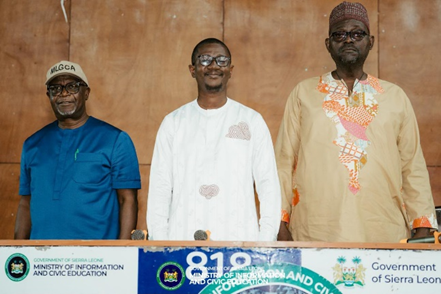
Speaking at the Ministry of Information and Civic Education’s weekly press briefing, the Minister of Local Government and Community Affairs, Ambassador Tamba John Lamina, said the conference will bring together Paramount Chiefs, Regent Chiefs, District Officers, Provincial Secretaries, political and administrative leaders of all 22 local councils, the Office of National Security (ONS), and representatives from key government ministries.
According to the Minister, the conference will create an unprecedented platform for dialogue on governance, security, development and institutional reforms.
“This is the first time all these critical stakeholders are coming together under one roof to discuss how we can strengthen governance and improve development across Sierra Leone,” he said.
Minister Lamina disclosed that President Julius Maada Bio considers the conference a national priority and is expected to officially open the event, underscoring the government’s commitment to strengthening traditional institutions.
Describing chieftaincy as the foundation of rural governance, the Minister said Paramount Chiefs have remained central to preserving peace, administering land, protecting cultural heritage and resolving disputes within their communities.
However, he noted that changing times require traditional institutions to adapt to new realities.
“Our society is evolving through modernization and digital transformation. Young people and women are demanding greater participation in governance, and we must ensure our traditional institutions evolve while preserving their core values,” he said.
The Minister explained that discussions during the conference will focus on inclusive governance, community security, financial management, land administration, conflict resolution and strengthening cooperation between chiefdom authorities, local councils and central government.
He revealed that representatives from the Ministry of Finance, the Ministry of Lands, the Ministry of Planning and Economic Development, the Law Officers’ Department and several other institutions will participate in the discussions to ensure coordinated policy implementation.
Another major issue expected to dominate the conference is the ongoing review of the Chieftaincy Act of 2009. Minister Lamina said recommendations from the gathering will help shape proposed reforms to ensure the legislation reflects present-day governance realities.
He also highlighted reforms introduced by his Ministry to improve Paramount Chieftaincy elections, revealing that assessment committees are now established before elections to determine whether chiefdoms are adequately prepared.
According to him, the process allows communities to express concerns, promotes transparency and has significantly reduced tensions that previously characterized some chieftaincy elections.
“We would rather postpone elections than conduct them under conditions that could create conflict. Peaceful, transparent and credible elections remain our priority,” he stated.
The Minister acknowledged that governance reforms are not without challenges, citing vested interests, political interference and inadequate resources as key obstacles.
“Meaningful reform often affects existing interests, so resistance is inevitable. But we remain committed to reforms that will strengthen local governance and improve service delivery,” he said.
He stressed that greater participation by women and young people must form part of future governance reforms, describing inclusion as essential to sustainable development.
“You cannot build modern governance without involving women and young people. They are indispensable partners in the development of our communities,” he added.
Also speaking at the briefing, the National Secretary General of the National Council of Paramount Chiefs and Paramount Chief of Kamajei Chiefdom in Moyamba District described the conference as a landmark event that could reshape grassroots governance in Sierra Leone.
He said traditional leaders have played a vital role in nation-building since the colonial era, when the country’s chiefdoms entered into agreements that laid the foundation for modern Sierra Leone.
“Our role in national development is not new. Paramount Chiefs have always been at the center of community leadership and governance,” he said.
The traditional leader also reflected on the country’s civil war, recalling that many Paramount Chiefs remained in their communities despite the dangers and worked with their people to preserve peace and stability.
“When many people fled during the war, Paramount Chiefs stayed with their communities. We stood by our people and contributed to restoring peace in this country,” he said.
He noted that the conference presents an opportunity for traditional authorities and government to jointly examine issues affecting chiefdoms and identify practical solutions to challenges facing rural communities.
According to him, development can only succeed when communities are fully involved in planning and implementation.
“If development begins with the people, they will own it and protect it. But when communities are excluded, many projects eventually become white elephants,” he cautioned.
He expressed optimism that the conference would strengthen collaboration between traditional authorities and government institutions, promote community ownership of development initiatives and reinforce the role of Paramount Chiefs in advancing peace, stability and national development.
The conference is expected to produce recommendations that will guide reforms within the chieftaincy institution while deepening cooperation between central government, local councils and traditional authorities in building stronger and more inclusive communities across Sierra Leone.