Govt Articulates Reforms For Sustainable Growth & National Development
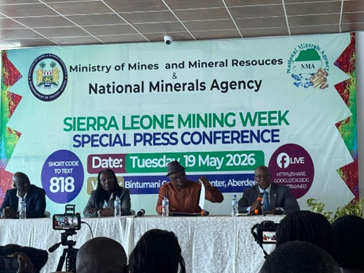
As Sierra Leone officially commenced its Mining Week 2026 activities at the Bintumani Hotel Conference Hall in Freetown, government officials, mining executives and regional industry leaders used the platform to project confidence in the country’s mineral sector, while also drawing attention to the challenges surrounding transparency, local benefits and sustainable resource management.
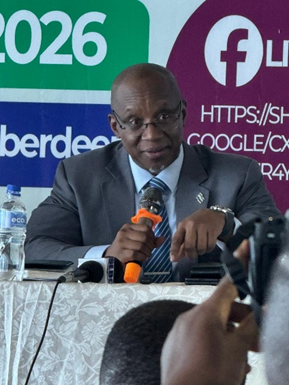
The Ministry of Mines and Mineral Resources and the National Minerals Agency on Tuesday, 19th May 2026, held a press conference ahead of the official opening ceremony scheduled for Wednesday, 20th May 2026, which was chaired by the Vice President of Sierra Leone, Mohamed Juldeh Jalloh.
This year’s Mining Week was held under the theme: “Our Mineral Resources: Responsible Mining, Value Multiplication and Shared Prosperity,” a slogan that reflects the government’s renewed efforts to present the extractive sector as a key pillar for economic growth and social transformation.
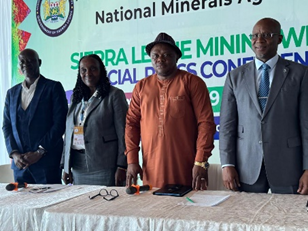
The week-long event, which began on 19th May and ended on 23rd May 2026, attracted mining companies, financiers, government ministries, civil society actors, development partners and representatives of mining communities from across the country.
However, beneath the ceremonial atmosphere and investment-focused presentations lies an ongoing national debate over whether Sierra Leone’s mineral wealth is truly translating into meaningful development for ordinary citizens and mining host communities.
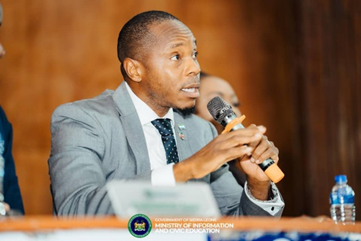
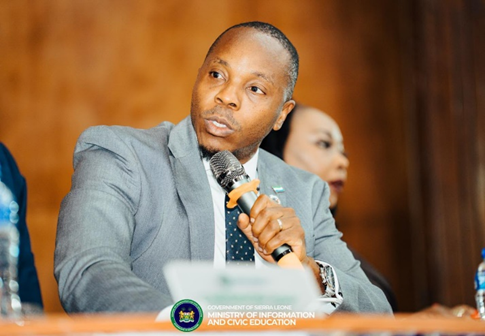
Addressing the press conference, the Minister of Mines and Mineral Resources, Julius Daniel Mattai, emphasized that the Mining Week was designed to create dialogue among all actors within the sector, while promoting reforms intended to strengthen accountability and value addition.
He stated that the event brought together “various stakeholders like mining companies, financiers, line ministries and agencies, and key stakeholders working in the sector.”
Minister Mattai said the Mining Week comes at a critical moment for Sierra Leone, as the country continues to strengthen its role within African mineral governance structures, particularly through leadership in the African Diamond Producers Association.
He disclosed that Sierra Leone’s position in continental mining leadership has enhanced the country’s visibility in international mining discussions, especially within the diamond trade.
“Africa is responsible for a significant proportion of rough diamonds produced in the world,” he said, while stressing the need for African countries to secure greater value from their natural resources rather than merely exporting raw minerals.
The Minister pointed to reforms introduced by government, including the Critical Mining Strategy and the Community Development Mining System, which he described as mechanisms aimed at improving governance, ensuring transparency and promoting community participation in mining activities.
“These are all value additions in the sector,” he noted. “We have a shared prosperity agenda to ensure that everyone in the sector benefits.”
Yet, despite those assurances, concerns remain among advocacy groups and some mining communities regarding environmental degradation, land disputes, uneven compensation arrangements and limited local economic opportunities in areas where large-scale mining operations are taking place.
Several community leaders who attended previous mining engagements have repeatedly called for stronger monitoring mechanisms to ensure that mining companies comply fully with environmental and social obligations.
While the Ministry and the National Minerals Agency continue to promote responsible mining policies, observers say implementation and enforcement remain the true tests of the reforms being announced.
Minister Mattai maintained that the government wants the mining sector to benefit both the nation and the communities in which companies operate. He highlighted the inclusion of women in mining, youth groups and community representatives in the Mining Week activities, describing their participation as evidence of a more inclusive approach to mineral governance.
He also stressed that the National Minerals Agency continues to play a central role in implementing mining regulations and overseeing compliance within the sector.
Representing the private sector, Salim Sillah, Chief Technical Officer of Leone Rock Metal Group, praised the government for what he described as improved stability and investor confidence within the industry.
According to him, mining companies are now operating in a more secure environment, with clearer tenure systems and stronger engagement between companies and host communities.
“There is now confidence in operating in the mining sector and those operating in the sector feel safe in the tenure they acquire,” Sillah stated.
He further noted that communities surrounding mining operations are increasingly being respected and empowered through consultations and development initiatives.
Industry analysts, however, say the issue of “shared prosperity” remains one of the most sensitive questions facing Sierra Leone’s mining industry. While mining exports continue to contribute significantly to national revenue, critics argue that visible poverty still persists in several mineral-rich districts.
Economic observers also note that the challenge for Sierra Leone is not simply attracting mining investment, but ensuring that mining revenues are translated into roads, schools, healthcare, clean water and sustainable employment opportunities for citizens.
Sillah acknowledged that Sierra Leone is currently at an important stage in the growth of its mining industry, and stressed the need to prioritize value addition rather than relying solely on raw mineral exports.
“We are laying premium on value additions in the sector, which will help build the sector and the nation,” he said.
Also speaking at the press conference was Mrs. Ellah Muchemwa, Executive Director of the African Diamond Producers Association, who commended Sierra Leone’s leadership within Africa’s mining sector.
She described the Association as an intergovernmental organization representing 22 member states and working to strengthen Africa’s collective influence within the global diamond market.
According to her, the Association’s long-term vision is to promote a sustainable African diamond industry capable of delivering greater benefits to producing nations.
Mrs. Muchemwa praised Sierra Leone for pursuing reforms aimed at improving mining efficiency and regulatory systems.
“Sierra Leone’s leadership has been exemplary and has shown commitment in showcasing effective and efficient mining while ensuring reforms that regulate the sector,” she stated.
She added that the Association continues to support member states through capacity development and technical assistance programmes.
As the Mining Week progresses, expectations remain high that discussions held during the event will move beyond policy declarations and address the practical realities facing communities affected by mining operations.
For many Sierra Leoneans, the central question remains whether the country’s vast mineral wealth can finally become a true engine for inclusive development, environmental responsibility and long-term national prosperity rather than a source of recurring controversy and inequality.