By: Alimatu Kargbo
On the 7th May 2026,
The Sierra Leone Meteorological Agency (SLMET) launched its 2026 National Seasonal Outlook and Forecast (NSOF) with a clear message, no forecast will be issued for any area where there is no working weather station. The agency, which has evolved from a colonial‑era department under Transport and Aviation to an autonomous body, now under the Ministry of Environment and Climate Change, says it is blending hard infrastructure, local expertise, animal behaviour, and 30 years of daily data to guide the nation through another rainy season.
Speaking at the launch, Communications Director, Sucess Ibrahim Sei Kamara, reminded the audience that SLMET began training media personnel as far back as 2020. “How do we move the media to speak with what we do here?” he asked. He gave a brief history, furthering that the Met Department was one of the first meteorological outfits created in West Africa by the British. After independence, it remained under the Ministry of Transport and Aviation, mostly known for controlling air navigation, the information that makes airplanes land and take off. In 2017, the law was reviewed and the department became an autonomous agency. Then in 2022, another review moved the agency under the Ministry of Environment and Climate Change, alongside the National Protected Area Authority, EPA, Nuclear Safety Authority, and the Forestry Division. Crucially, the 2022 amendment also created a climate change department within SLMET.
Kamara welcomed partners, including Mr. Ali from Hong Kong, a CSO representative who has worked with the agency for years, and noted that civil society organisations have been vital in advocating for government support. He also thanked sister agencies and the Sierra Leone Broadcasting Corporation. “What we do here is purely scientific,” he said. “When my boss presents, you will see.” He confirmed that a technical session had already been held with the National Disaster Management Agency (NDMA) to share expectations for the coming season.
The agency’s leadership is tight, a Director General (Head of Operations) Mr. Gabriel Kpaka for Operations, both appointed by His Excellency the President. Today’s forecast for 2026 was described by insiders as “the most difficult presentation” because the public judges the agency by what it expects.
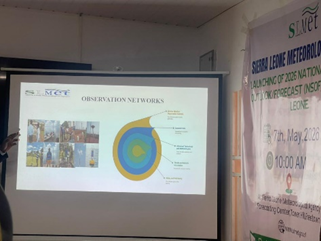
The technical team walked through the country’s station network. Manual stations (Stevenson screens) require a person to take readings at specific hours, mainly at airports. Automatic stations report every thirty minutes, and for critical needs such as construction, every five minutes. Airport station data is not shared publicly for security reasons, to prevent hijackers from using the information. Pilots and SLMET use coded language that only they understand. Agricultural stations measure plant and ground temperature, and there are sixty contact stations across the country reinforced with Chinese technology.
One example drove the point home, if a station records twenty millimetres of rain in one hour and the rain continues heavily, some citizens may suspect fraud. But in Sierra Leone’s hilly and mountainous topography, the agency has recorded up to fifty millimetres in an hour. “That is not fraud,” a forecaster explained. “That is the terrain.”
The agency does not rely on guesswork. It processes data using specialised software and maps, and it consults major global centres such as NOAA in the United States and ECMWF in Europe. Those models give a broad picture, which SLMET then downscales using local expert knowledge. “No model is as good as a real expert,” the team said. An experienced forecaster who has been in the system for a long time can produce a focused forecast without any model, simply by knowing the land, the sunrise, the solar intensity, and why the northern part of the country gets more sunlight and more dry spells.
Remarkably, the agency also observes animals. “You can look at any animal know its age, know if it is pregnant, and it will tell you when it will give birth. It can even tell you the exact day you will have rainfall,” one official said. While SLMET cannot say “no rain on this Saturday” with absolute certainty, the combination of animal signals, station data, and expert judgment can give specific dates.
The scientific backbone is a thirty‑year daily dataset from 1995 to 2024. The civil war years left gaps, but machine learning and artificial intelligence have been used to read backwards and replace the missing records. The system was trained on 1995‑2024 and tested against 2025, a year for which the agency already has complete data. That validated model now informs the 2026 operations. “That thirty‑year baseline tells us what is normal and what is extreme,” the team said. “When we combine it with global models, expert knowledge, and even animal behaviour, we can tell farmers and citizens: on this date range, in this district, expect this amount of rain.”
For 2026, the seasonal outlook will be disseminated through radio, the NDMA, and partner media. The agency acknowledges that developed countries have auto‑screen graphics, but Sierra Leone is building something different: an honest, infrastructure‑based system that does not pretend to forecast where no station exists. “We don’t do this by guessing,” the presentation concluded. “We do it with stations, experts, thirty years of data, and the living world around us.”
The launch took place on 7th May 2026, just one week into the rainy season. A couple of days earlier, the Western Area had already received its first intense drop of rainfall. With that, SLMET officially put the country on notice, the 2026 rains are here, and the agency is ready.