By: Alimatu Kargbo
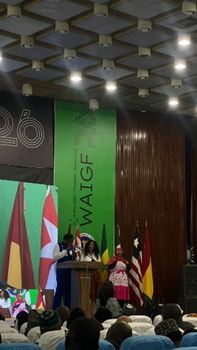
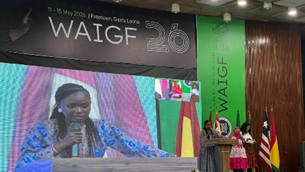
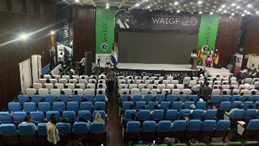
West Africa has taken a bold step toward redefining its digital future as policymakers, tech leaders, regulators, civil society actors, youth representatives, and development partners gathered in Freetown, during the West Africa Internet Governance Forum (WAIGF 2026) at the Miatta Conference Centre, Youyi Building.
Held under the theme “Digital Sovereignty and Economic Value in West Africa’s Integrated Digital Market,” the forum has become a critical space for shaping how the region governs the internet, builds digital infrastructure, and unlocks economic opportunities in the fast-growing digital economy.
The gathering brings together stakeholders from across West Africa to discuss key issues including internet governance, artificial intelligence, cybersecurity, digital policy harmonization, innovation ecosystems, and data governance.
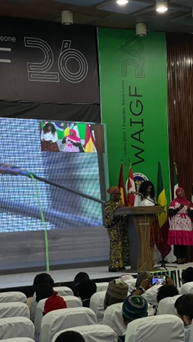
In a powerful keynote reflection, Sierra Leone’s Minister of Communication, Technology and Innovation, Salima Monorma Bah, urged participants to move beyond speeches and focus on concrete action.
She emphasized that the forum should not only be about discussion, but about identifying practical steps that can accelerate digital transformation across the region.
“We are speaking to a room of converts,” she noted, stressing that the real challenge is no longer awareness, but implementation.
The Minister welcomed delegates to Sierra Leone, describing Freetown as a symbol of resilience and transformation. She highlighted the country’s history in hosting earlier internet governance conversations and noted how far infrastructure and connectivity have improved over the years.
A major focus of her address was the need to transform internet access into real economic value.
“The central question we must ask is how the internet translates into economic value for our people,” she said, pointing to the global digital economy, which now contributes trillions of dollars to global GDP, while Africa’s share continues to grow but remains underdeveloped.
She stressed that Africa’s greatest resource is not its minerals or natural wealth, but its people.
Unlike extractive resources that can be depleted, she said, human creativity, innovation, and talent are unlimited, and must be fully developed through education and investment in human capital.
“The resource we will never exhaust is our people,” she emphasized, calling for stronger investment in education, skills development, and youth empowerment.
The Minister also highlighted the importance of supporting homegrown innovation, noting that African-designed solutions are often more impactful because they reflect local realities and needs.
She further called for a shift in how regulation is viewed, not only as a tool for control, but as an enabler of innovation, investment, and digital market growth.
The forum also reinforced the ECOWAS regional vision, with speakers noting that economic transformation is central to peace, stability, and security in West Africa. Without economic opportunity, they warned, young people will continue to seek risky migration routes in search of better futures.
Speakers emphasized that digital transformation must now sit at the heart of West Africa’s development agenda, particularly as the global digital economy continues to expand rapidly.
Throughout the event, participants highlighted the urgent need for policy harmonization, stronger regional cooperation, improved digital infrastructure, and inclusive digital governance frameworks that ensure no country or community is left behind.
The WAIGF 2026 is expected to conclude with actionable recommendations aimed at strengthening West Africa’s position in global digital governance and accelerating the region’s transition toward a more integrated and competitive digital economy.
As discussions continue, one message is clear that West Africa is no longer asking whether it should join the digital economy, but how fast it can shape it.