
Presidential working visit highlights government’s drive to transform rice production, strengthen food security and accelerate the implementation of Feed Salone.
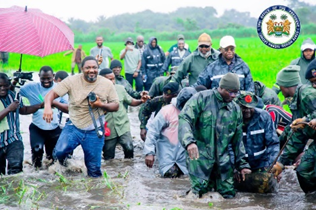
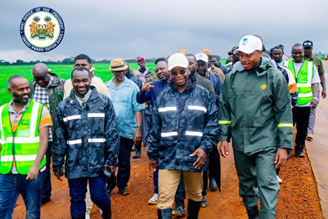
has undertaken a working visit to assess progress on the Torma-Bum Irrigation Scheme and the development of integrated rice processing infrastructure. He also toured the ‘Fambul Rice’ and Republic of Sierra Leone Armed Forces’ Rice Farms in Bonthe District.
The investments are being implemented through the Ministry of Agriculture and Food Security under the Sierra Leone Regional Rice Value Chain Development and the Sierra Leone Rice Agro-Industrial Cluster Projects funded by ISDB-BADEA and AfDB, respectively. Together, the projects are designed to transform Torma-Bum into a strategic Centre for large-scale irrigated rice production, processing, storage and marketing.
Warm reception in Torma-Bum
Upon arrival, President Bio was warmly received by the Minister of Agriculture and Food Security, Dr Henry Musa Kpaka, alongside other government ministers and senior officials.
Also present to welcome the President were the Chief of Defence Staff of the Republic of Sierra Leone Armed Forces, Lieutenant General Amara Idara Bangura; the Paramount Chief of Bum Chiefdom; senior military officers; representatives of the Bonthe District administration; project implementation officials; traditional and community leaders; farmers; women’s groups; young people and residents of surrounding communities.
The reception reflected the importance attached to the President’s visit and the strong collaboration among the central government, local authorities, traditional leadership, the military, development partners and farming communities in advancing Sierra Leone’s food-security agenda.
President Bio was accorded full courtesies before receiving technical briefings on the status of the infrastructure, the area being prepared for cultivation, the ‘Fambul Rice’ and the military’s rice-production fields and the anticipated contribution of the investments to national rice self-sufficiency.
Inspection of the irrigation scheme
During the visit, President Bio toured sections of the Irrigation Scheme, where significant infrastructure is being developed to provide reliable water supply for large-scale rice cultivation.
The Minister of Agriculture and Food Security shared updates on the ongoing construction of the pumping facilities, main and secondary canals, water-control structures, drainage channels, access routes and land-development activities.
The irrigation development is intended to reduce farmers’ dependence on rainfall and make it possible to undertake more predictable and intensified rice production. When fully operational, the infrastructure will support improved water management, increase the amount of cultivable land and create opportunities for dry-season farming and multiple production cycles.
Minister Kpaka explained that the first two irrigation sectors cover approximately 2,000 hectares, covering more than 25 kilometers of main and branch canals. The Minister added that Torma-Bum is being developed as an integrated agro-industrial rice cluster connecting land development and irrigation with mechanization, aggregation, processing, storage, packaging and access to domestic markets.
He emphasized that the investments demonstrate the government’s transition from seasonal and subsistence production towards a coordinated, private sector-led, commercial rice production.
Dr Kpaka expressed appreciation for President Bio’s continued leadership and personal commitment to Feed Salone, noting that regular presidential oversight helps maintain implementation momentum and reinforces accountability across participating institutions.
The Minister also acknowledged the cooperation of the RSLAF, the private sector, traditional authorities, farming communities, contractors, project personnel and development partners supporting the government’s agricultural transformation programme.
Visit to ‘Fambul Rice & the Military Rice Farms
President Bio also visited the Rice Farms currently cultivated by ‘Fambul Rice, a private sector investment, and the Republic of Sierra Leone Armed Forces as direct support to the national food-security agenda through direct involvement in large-scale rice production.
Lieutenant General Amara Idara Bangura briefed the President on the military’s agricultural operations, including land preparation, deployment of personnel and machinery, cultivation activities and plans to expand production.
The military farming initiative forms part of a wider strategy to strengthen the RSLAF’s institutional food security while contributing to national rice supply. It also demonstrates how state institutions can utilize available land, personnel, technical capacity and machinery to support productive economic activities.
The Chief of Defence Staff reaffirmed the RSLAF’s readiness to work with the Ministry of Agriculture and Food Security and local communities to improve productivity and expand the area under cultivation.
The military’s involvement is particularly significant because it provides opportunities to enhance operational discipline, improve the management of agricultural machinery and establish a dependable production system capable of supporting both the Armed Forces and the wider population.
Rice processing and value addition
The President’s visit also focused on rice-processing infrastructure being developed under the Rice Agro-Industrial Cluster Project.
The processing facilities are expected to strengthen the downstream segment of the rice value chain by improving drying, cleaning, milling, grading, packaging and storage. This will help reduce post-harvest losses, improve the quality of locally produced rice and enable domestic products to compete more effectively with imported brands.
The Rice Agro-Industrial Cluster Project has the broader objective of contributing to national rice self-sufficiency while improving rural livelihoods. Its interventions include improving farmers’ access to quality inputs, land and water management, mechanization and extension services, as well as promoting the processing and marketing of high-quality local rice.
By linking production to processing, the government seeks to address one of the longstanding constraints facing Sierra Leonean rice farmers: the absence of sufficient modern facilities to convert locally produced paddy into consistently high-quality, market-ready rice.
Feed Salone in action.
President Bio’s working visit underscores his government’s determination to make agriculture a central driver of national development through Feed Salone.
The initiative prioritizes increased domestic food production, reduced dependence on imports, greater private-sector participation, job creation and the development of efficient and climate-resilient agricultural value chains.
Torma-Bum is strategically important to this agenda because of its extensive fertile riverine grasslands, water resources and suitability for large-scale mechanized rice production. Through the combined development of irrigation, mechanization, processing and storage facilities, the area has the potential to become one of Sierra Leone’s leading rice-production zones.
President Bio’s visit has renewed national attention on Torma-Bum and reaffirmed the government’s commitment to transforming the area into a productive, inclusive and commercially sustainable rice hub.